An Overview of Foreign Driver's License Conversion: What is Foreign Driver's License Conversion? Overall Process, Conditions, Required Documents, and Costs
First, the conclusion
Skill assessment is based on a point deduction system starting from 100 points. A score of 70 points or higher is the minimum requirement.
The skills test assesses not only your driving technique but also your signaling, safety checks, driving on the left side of the road, turning left or right, and how to handle pedestrian crossings and railway crossings. Dangerous behavior, the examiner's assistance with braking, and exceeding the penalty point limit will result in immediate termination of the test.
Legal basis: National Police Agency "Guidelines for Handling Matters Related to Foreign Driver's Licenses", National Police Agency "Revision of Procedures for Converting Foreign Driver's Licenses (Draft)"
Even if you've been driving in your home country for a long time, you'll accumulate penalty points if you're not accustomed to Japan's left-hand traffic, right-hand drive vehicles, and the order of visual checks. This article will explain the test system, changes from October 2025, important actions, and how to practice in order.
Basics of the Exam
The skills assessment involves driving on an on-site course to confirm safe driving practices in the Japanese style.
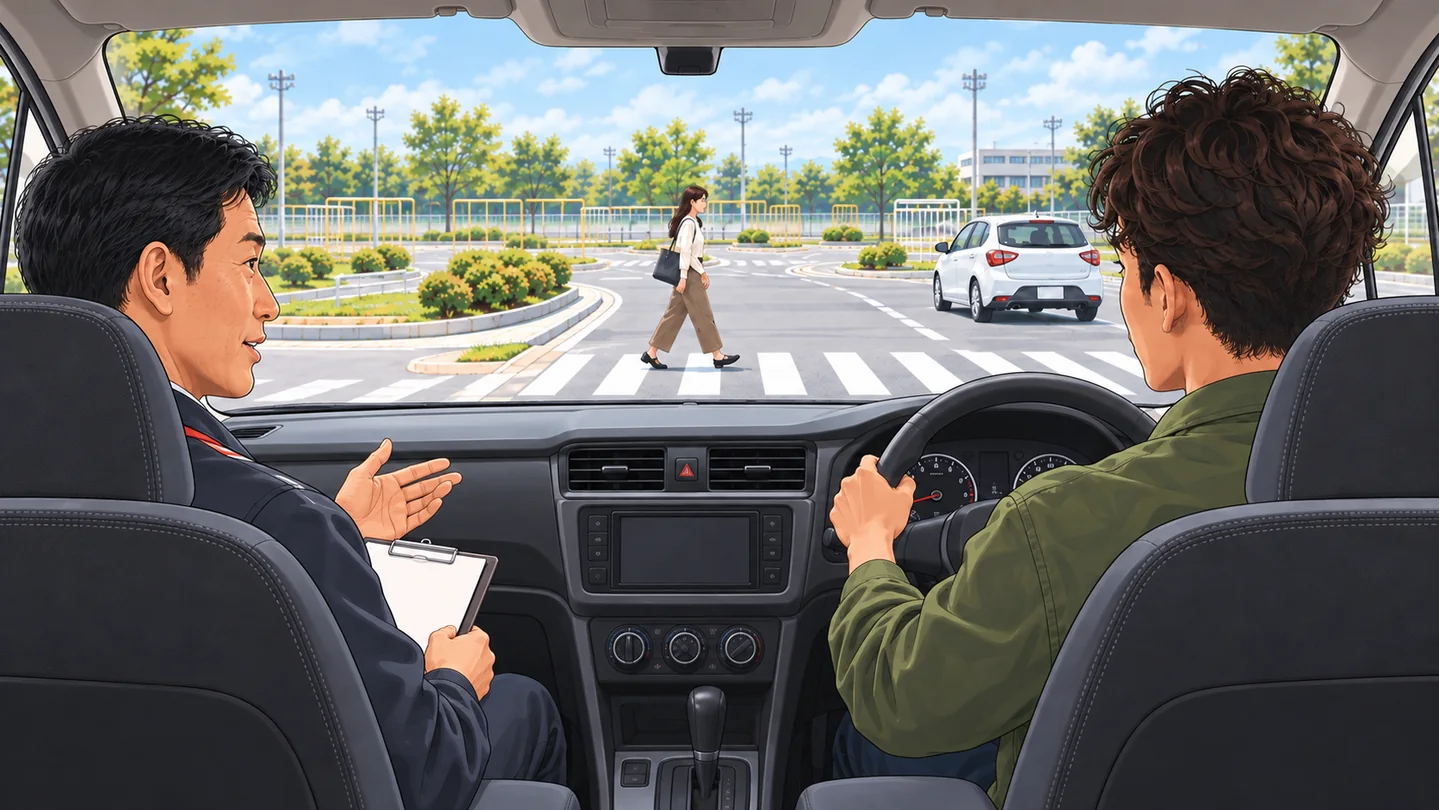
The skills test for a standard driver's license is conducted on a course at a driver's license center or similar facility. Applicants follow the examiner's instructions and are assessed on their ability to drive safely in situations such as starting, driving position, intersections, turns, pedestrian crossings, railway crossings, and narrow roads. The course and testing methods vary depending on the application location and license category.
| Grading | Points are deducted from a starting point of 100. | The minimum score is 70 points. |
|---|---|---|
| mileage | Normal, semi-medium, medium, large, etc. | Over 1,200 meters |
| Scope of Confirmation | It's not just about driving. | From before boarding, starting, driving, stopping, and disembarking. |
| result | Don't judge solely on pass or fail. | I will incorporate the pointed-out actions into my next practice session. |
The pass rate immediately after the system change was 13.1%.
According to nationwide statistics released by the National Public Safety Commission for October to December 2025, the pass rate for skills certification was 13.1%. This is lower than the 30.4% recorded in 2024. While this figure is for the first three months after the system change and may fluctuate in the future, it indicates the importance of prior practice with actual vehicles.
Source: Summary of the National Public Safety Commission Chairman's Press Conference (March 5, 2026)
Skill assessments continue from before boarding until after disembarking.
- 1Before boarding
Check the front, back, surroundings, and underside of the car to ensure there are no people or obstacles. Also check behind you before opening the door.
- 2Boarding and preparation
Close the doors securely, and adjust the seats, rearview mirror, side mirrors, and seatbelts. Also check the status of the automatic/manual transmission and the parking brake.
- 3Launch
After starting the engine, check the mirrors, signal, and then visually inspect the area. Judge when it is safe to do so, accelerate as needed, and join the flow of traffic.
- 4Task run
Following the examiner's instructions, you will drive through intersections, make right and left turns, crosswalks, railway crossings, obstacles, and narrow roads. Prioritize safety checks over following the designated route.
- 5Stop
Safely pull over to the designated spot, then turn off the engine by operating the brakes, shifter, and parking brake in the correct order.
- 6Get off
Check behind you using the mirrors and by looking directly before opening the door. After getting out of the vehicle, be careful not to obstruct surrounding traffic.
Stricter regulations to be implemented from October 2025.
With the addition of challenges such as crosswalks, scoring for signaling and turning has also become stricter.
From October 1, 2025, the skills assessment will include additional tasks such as crossing pedestrian crossings. Actions such as failing to signal or having an inappropriate driving position when turning right or left will also be checked more strictly, using the same criteria as when obtaining a new license.
pedestrian crossing
We will check for pedestrians and their movements early on, and approach at a speed that allows us to stop reliably when necessary.
sign
It's not just about whether or not to give a signal; it's also about the timing of giving the signal, when to turn it off, and the sequence of actions including safety checks.
Turn right or left
We will practice separately how to position the car before turning, how to slow down, where to position it within the intersection, and how to check for pedestrians and cyclists.
Railroad crossing
We will confirm the stopping position, check left and right, the decision not to stop within the level crossing, and the operation when passing through.
Vehicle-specific changes in April 2026
For medium-sized, semi-medium-sized, and medium-sized Class 2 licenses, the introduction of automatic transmission (AT) licenses and revisions to the manual transmission (MT) skills test procedures came into effect on April 1, 2026. This does not mean that the same changes have been applied uniformly to everyone who wishes to convert their regular driver's license to a foreign license. Please check with the application office regarding your desired license category and AT/MT conditions. Those wishing to obtain a semi-medium-sized license can also check the detailed procedures for semi-medium-sized AT-only licenses and MT skills tests.
Vehicle-specific regulations: National Police Agency, "Regarding the introduction of automatic transmission (AT) large vehicle licenses and the review of the methods for practical skills tests for manual transmission (MT) licenses."
Things that differ depending on where you apply
The timing and location of the skills assessment vary by prefecture.
While the scoring criteria for skills assessments are the same nationwide, the booking process, whether it's on the same day as the knowledge assessment, and the available practice locations differ depending on where you apply. We compared the four prefectures with the highest number of applicants.
| Tokyo | Date of treatment: Treatment will be conducted in Fuchu or Samezu. Since it is by appointment only, treatment cannot be received on the same day of registration. Practice at the testing center: Courses in Fuchu and Samezu are open to the public (Saturdays and public holidays, 2,000 yen per hour + insurance fee. You must provide your own instructor and practice vehicle). |
|---|---|
| Osaka Prefecture | Date of examination: The examination will be held in Kadoma or Komyoike on a different day from the document review and knowledge assessment. It may take a long time until the designated date. Practice at the testing center: Kadoma course open to the public (Saturdays and Sundays, 50 minutes for 3,500 yen. You must provide your own instructor and practice vehicle.) |
| Kanagawa Prefecture | Date of Examination: After passing the knowledge check, you will take the exam on your scheduled date. Online reservations are currently suspended as of August 31, 2026; please make your reservation in person or by phone. Practice at the testing center: The driver's license center's course is open to the public (reservations required by the Kanagawa Prefectural Traffic Safety Association). |
| Chiba Prefecture | Date of examination: Generally, it is taken on the same day as the knowledge check. Reservations for the knowledge check are booked up several months in advance. Practice at the testing center: You cannot practice at the Chiba Driver's License Center. |
Opening the test course requires you to provide your own licensed passenger and practice vehicle, so access is limited to certain individuals. For those who want instruction using a vehicle and course of the same specifications as the test, practicing at a designated driving school is the quickest route. Information for other prefectures can be found in the prefectural guide.
Source: Information on converting foreign driver's licenses from the Tokyo Metropolitan Police Department, Osaka Prefectural Police, Kanagawa Prefectural Police, and Chiba Prefectural Police (confirmed October 8, 2026)
ZIPLUS Practical Check
The Japanese-style safety check is standardized into "5 steps".
Self-assessment of "being able to drive" alone is insufficient to determine preparation for skill testing. Ensure you can perform the following five actions in the same order each time you start, change lanes, or turn left or right. This is not an official scoring sheet, but a ZIPLUS editing frame designed to identify any overlooked checks.
- Use the rearviewmirror and side mirrors to check for traffic behind and to the sides.
- Signals forlane changes should be given approximately 3 seconds in advance, and turns should be initiated approximately 30 meters before the intersection.
- Turn your head towards the blind spot that isn't visible in the rearviewmirror and check for motorcycles and bicycles.
- Keep to the left of theroad and move to an appropriate position before turning left or right.
- On straight stretches, accelerate as needed, and then slow down to a safe speed before turning.
Even if you say "Right clear, left clear," it doesn't count as checking unless your eyes and face actually move. During practice, have your passenger record the direction and timing of your checks.
Checklist while driving
10 Key Points for Skill Assessment
Before boarding and when alighting
Check the area around the car, including the front, back, and underside, for any hazards. Also, check behind the car before opening the door.
driving position
Adjust the seat, mirrors, and seatbelt to create a comfortable posture for operating the steering wheel and pedals.
Launch
Check your surroundings, give a signal, visually check your blind spots, and start smoothly at an opportune moment that will not obstruct following vehicles.
driving on the left
While driving on the left side of the road, avoid drifting too far to the left and maintain a safe distance from oncoming traffic.
Stop and traffic light
Stop the wheels completely just before the stop line. If visibility is poor, move forward slowly after stopping to check again.
change of course
Maintain the correct sequence of checking the mirrors, signaling, taking about 3 seconds, visually checking, and then moving, avoiding sudden steering maneuvers.
Turn right
Move towards the center, avoiding obstructing oncoming straight-ahead traffic and left-turning traffic, and proceed slowly just inside the center of the intersection.
Turn left
Pull over to the left edge of the road, slow down sufficiently, and visually check for motorcycles, bicycles, and pedestrians to your left rear.
Pedestrian crossings and railway crossings
At crosswalks, pedestrians have priority. At railroad crossings, stop, check left and right, and make sure there is space on the other side.
S-curves, cranks, etc.
Slow down and be mindful of the paths of the front and rear wheels. The presence and shape of the obstacles will vary depending on the venue and license category.
6 mistakes that even experienced drivers should be careful of.
The confirmation is only in my head.
Even if you are looking with your eyes, small facial movements may make it difficult for the examiner to see. Distinguish between using a mirror and looking directly, and clearly define the direction you are looking.
The order of signal and confirmation is reversed.
If you move your car first and then give a signal, your intentions won't be conveyed to those around you. Give a signal, check for safety, and then move.
I think it's safe at low speeds.
Driving unnecessarily slowly can be perceived as poor judgment or driving error. In safe areas, accelerate to a speed appropriate for the road conditions.
Too far to the left
Sometimes, focusing too much on driving on the left side of the road can lead to getting too close to the curb or the edge of the road. Practice to get a feel for the width of your vehicle and the position of your rear wheels.
The decision will be made according to the priority rules of the home country.
Avoid making decisions about right and left turns or priority at intersections based on your home country's customs. Use signs, markings, and Japanese traffic rules as your basis.
Responding to instructions, sudden maneuver
Even if the indicated location is nearby, avoid sudden changes of course. If it is not safe to proceed, continue straight ahead and wait for further instructions.
Avoiding obstacles is also considered "changing lanes."
When avoiding parked vehicles or construction zones, do not just look straight ahead and turn the steering wheel; check behind you, signal, and visually inspect the area. Judge not only the lateral distance to the obstacle, but also the timing to avoid obstructing oncoming or following vehicles. Checking your surroundings is also necessary when returning to your original position.
Prioritization should not be determined by a single keyword.
Check priority roads, road widths, signs and markings, traffic lights, and the order in which to enter intersections. Remember only "left-hand priority" and don't overlook priority roads or stop signs. In places where you can't make a decision, slow down and observe the movement of other traffic.
Running to the end doesn't guarantee passing.
Main actions that may lead to the cancellation of the exam
The scoring is based on a point deduction system, but highly dangerous actions may result in immediate termination. The National Police Agency's skills test implementation standards list dangerous actions, assistance from the examiner, exceeding the point deduction limit, and violation of instructions as reasons for termination.
- Running a red light / Failing to stop at a designated locationThey don't obey red lights or stop signs.
- They mistook the traffic lane for right-hand trafficand obstructed other traffic.
- Failure to protect pedestrians:Not giving priority to pedestrians at crosswalks.
- Contact, major wheel derailment, inability to pass:Contact with curbs or obstacles prevents safe completion of the task.
- The examinerwill assist with braking and steering to help avoid dangerous situations.
- The driver disregarded the examiner's instructionsand proceeded despite the given driving directions.
If you take the wrong route, listen to the examiner's instructions and correct it safely. It is important to avoid dangerous actions such as sudden lane changes or reversing.
Reference for scoring and cancellation criteria: National Police Agency "Standards for Conducting Driver's License Skills Tests"
Instructions in Japanese
The examiner's instructions will be in Japanese. Remember the commonly used expressions.
While the knowledge test can be conducted in a foreign language, the examiner will give directions in Japanese during the skills test. If you panic because you can't understand, you might miss signals or safety checks. Familiarize yourself with the following expressions beforehand. The wording may vary depending on the venue and the examiner.
| Example of instructions | Meaning/What it does |
|---|---|
| "Please start the vehicle." | Check your mirrors, signal, and visually confirm before starting to drive. |
| "Turn right (or left) at the next intersection." | Turn right (left) at the next intersection. Give your signal at least 30 meters beforehand. |
| "Turn left at the end of the corridor." | Turn left at the end of the road (T-junction). |
| "Please walk around the perimeter." | We will run along the outermost part of the course. |
| "Just keep going straight." | Go straight without turning. |
| "Please enter the S-curve (crank)." | We drive along a winding, narrow road (a narrow road with right-angle turns). |
| "We are crossing the railroad crossing." | Stop before the railroad crossing, check left and right, and then cross. |
| "Please pull over to the left and stop." | Give a signal, pull over to the left edge of the road and stop. |
| "Please return to the departure/arrival point." | We'll return to the starting point. This is a sign that the test is nearing its end. |
Even if you miss an instruction, do not make sudden steering maneuvers or lane changes. Continue safely, and the examiner will give you further instructions. Dangerous maneuvers will result in greater point deductions or even termination of the test than making a wrong turn.
The SAMURAI DRIVER skills assessment preparation video is available in Japanese, English, Chinese, and Vietnamese, and allows you to review 10 key points for skills assessment.
Practice driving before the exam
The practice consists of three stages: "vehicle awareness → confirmation form → simulated driving".
Get used to driving on the right and on the left side of the road.
From the driver's seat, check the width of the vehicle on the left side, as well as the positions of the turn signals, wipers, gear shift, and parking brake. Start by driving slowly to get used to the vehicle's dimensions.
Fix the actions one by one.
Separate the five actions—starting, changing lanes, turning right, and turning left—and repeat them until the order of these five actions becomes unconscious and consistent.
Continue driving while listening to instructions.
Assuming it's the actual test, I prioritize safety checks even when following a route I've never heard before. After completion, I record the reasons for any deductions for each individual action.
Practice model to prepare in 6-8 hours
6-8 hours is a rough estimate. The required practice time will vary depending on your driving experience, the length of your break from driving, and your experience with right-hand drive vehicles and left-hand traffic. Rather than focusing on the amount of time spent practicing, judge your readiness based on whether you can consistently reproduce the same safety checks and driving actions.
Checklist for the day of the exam
- I prepared the necessary items for my license, such as glasses or contact lenses.
- I chose shoes suitable for driving and clothing that wouldn't hinder my ability to operate the vehicle.
- I double-checked the venue, registration time, required documents, and reservation details.
- If you cannot hear the examiner's instructions, confirm them before starting.
- Prioritize speed, signals, and safety checks over memorizing the course.
To companies that support foreign employees
Connecting exam preparation with on-the-job driving training after obtaining a license.
If your only goal is to pass the skills assessment, you may still have issues when driving on public roads after obtaining your license. Please transfer your practice records to the safe driving education program and have them reviewed, including the type of vehicle, route, and time of day you will be using it for work.
Verification of experience
In addition to the number of years of driving experience in your home country, check whether you drive on the left or right side of the road, whether you use automatic or manual transmission, the type of vehicle, and the period during which you haven't driven.
Practice log
The five actions were recorded in three stages: "completed," "completed after feedback," and "not achieved," and weaknesses were shared.
Reservations and work
Based on the skills assessment date, the possibility of retaking the exam, and anticipated practice days, we will determine the work shift and expense coverage.
Confirmation after acquisition
Training covers topics such as whether a beginner driver sign is necessary, how to operate a company vehicle, parking, refueling, and how to contact someone in case of an accident.
FAQ
Q&A on Skills Verification for Foreign License Conversion
If I've been driving in my home country for a long time, can I pass the test without any practice?
Even if you have driving experience, Japan has different rules regarding left-hand traffic, right-hand drive vehicles, and safety check procedures. We recommend checking Japanese vehicles and rules before you actually drive.
Can I pass the exam if I memorize the course?
Knowing the route will give you more confidence, but what will be graded is safe driving behavior. Focus on memorizing and make sure you don't forget to use signals and check your surroundings.
Do you always stop before a crosswalk?
This does not mean that you must stop indiscriminately even if it is clear that there are no pedestrians. Check for pedestrians, and if there are people attempting to cross, come to a complete stop before reaching them. Follow the examiner's instructions and the conditions on the course.
If I go off the road in an S-curve or sharp turn, is it okay for me to reverse myself?
Do not continue operating the vehicle on your own; first, bring the vehicle to a safe stop and confirm the examiner's instructions. A major wheel coming off or collision may result in the test being stopped.
Is it possible to switch to an automatic transmission-only license?
You may be able to request a license with restrictions such as a lower license category than what your foreign license allows you to drive, or a license limited to automatic transmission vehicles. Please check the desired license category and conditions when applying.
Can I take the skills assessment on the same day as the knowledge assessment?
Skills assessments typically require a separate appointment. In Tokyo, it is stated that skills assessments cannot be taken on the same day as application. Please check the appointment procedures at the application destination.