table of contents
- For those who are converting their foreign driver's license for the first time
- Why passing the knowledge test (written exam) will become more difficult from October 2025
- Japan's first app for knowledge verification (written exam) preparation: "Drivey"
- We handle everything from translation to knowledge verification and skill verification! What is the Foreign Driver's License Conversion "Safety Package"?
- Summary of example questions for knowledge confirmation (academic exam)
- To take the knowledge check (theoretical test)
- For those who are unsure about Japanese
- There are some countries that are exempt from the knowledge and skills verification when converting a foreign driver's license.
- lastly
For those who are converting their foreign driver's license for the first time
I want to obtain a driver's license while on a business trip or study abroad and switch to a Japanese license. I have a foreign driver's license, but I don't have a Japanese driver's license. I don't know what kind of test there is to change to a Gaimen license... For those of you who have such troubles! Changing your Gaimen license for the first time is full of anxiety. In this article, we will thoroughly explain the knowledge confirmation (theoretical test) of the two exams ``Knowledge Confirmation and Skill Confirmation'' that are conducted at the Gaimen Exchange. If you read this to the end, passing the exam on the first try will not be a dream! !
Why passing the knowledge test (written exam) will become more difficult from October 2025

Until now, the knowledge verification test for converting a foreign driver's license was a relatively simple test consisting of 10 true/false questions about basic Japanese traffic laws, and you could pass if you answered at least 7 questions correctly.
Since the questions were all illustrations, many could be answered intuitively, resulting in a very high pass rate of around 90%.
However, from October 2025, the exam will become significantly more difficult.
1. The scope of questions has been significantly expanded
The new format will include questions on the same content as the written test for the full driving license.
Specifically, the following broad areas are covered:
Key points of the exam (22 items)
| 1. Driver's Guidelines | 12. Behavioral analysis based on aptitude test results |
| 2. Obey traffic signals | 13. Human Performance and Driving |
| 3. Obey signs and markings | 14. Natural forces acting on cars and driving |
| 4. Where cars can and cannot pass | 15. Driving in adverse conditions |
| 5. Give way to emergency vehicles, etc., and maintain a safe speed and distance | 16. Characteristic accidents and tragedies |
| 6. Passing through intersections and railroad crossings | 17. Automobile maintenance management |
| 7. Pedestrian protection, etc. | 18. Parking and Stopping |
| 8. Checking for safety, signaling, using horns, changing lanes, etc. | 19. Riding, Loading and Towing |
| 9. Overtaking and passing | 20. How to respond in the event of a traffic accident, owner's guidelines, and insurance system |
| 10. Driver's License System and Traffic Violation Notification System | 21. Route Design |
| 11. Blind Spots and Driving | 22. Driving on the highway |
2. Tighter number of questions and passing criteria
Previously, you had to answer 7 out of 10 questions correctly (70% correct answer rate) to pass.
New format: Pass by answering 45 out of 50 questions correctly (90% correct answer rate)
→ The number of questions has increased fivefold, and only five mistakes are allowed.
3. Changes to the question format
Conventional: Illustration + True/False format (many visual clues)
New format: Except for traffic sign questions, illustration questions have been abolished.
→ You must understand the material based on the text, and reading comprehension skills are also required.
Summary of reasons for increasing difficulty
There are 22 items to memorize, so the amount of knowledge is enormous
**Pass rate dropped significantly from 90% to 30-40%**
* ZIPLUS research (November 2025)
The number of illustrations that can be solved intuitively has decreased, and accurate understanding is required.
Foreign test takers must also complete a full license level exam in a short amount of time.
These changes will transform an exam that previously most test takers were able to pass into one that is difficult to pass without sufficient prior study.
Japan's first app for knowledge verification (written exam) preparation: "Drivey"
■ App Features
1. Contains approximately 200 carefully selected questions
It analyzes actual exam trends and focuses on frequently appearing themes.
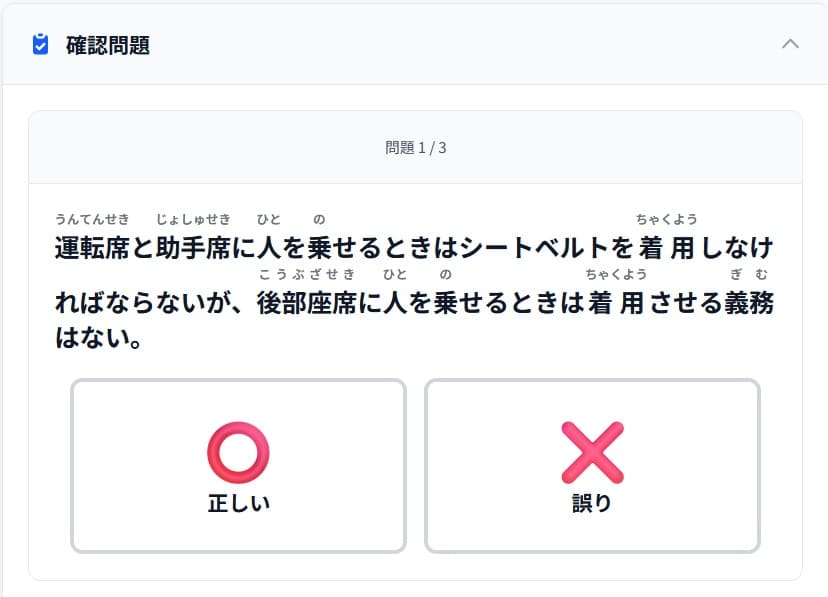
2. Detailed explanations via video
Intuitively understand important points such as traffic rules and safety checks through videos.
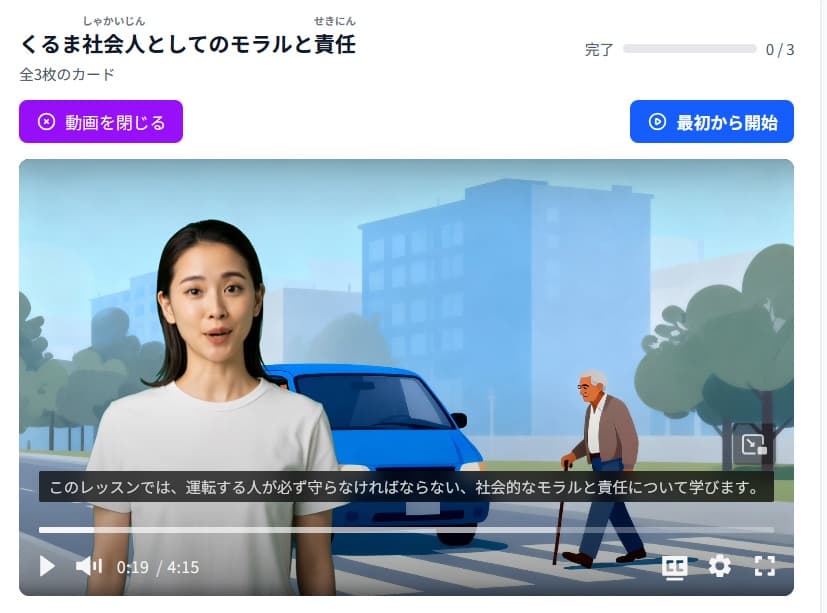
3. Interactive learning mode with AI
By utilizing AI technology, you can learn weak areas in an interactive manner.
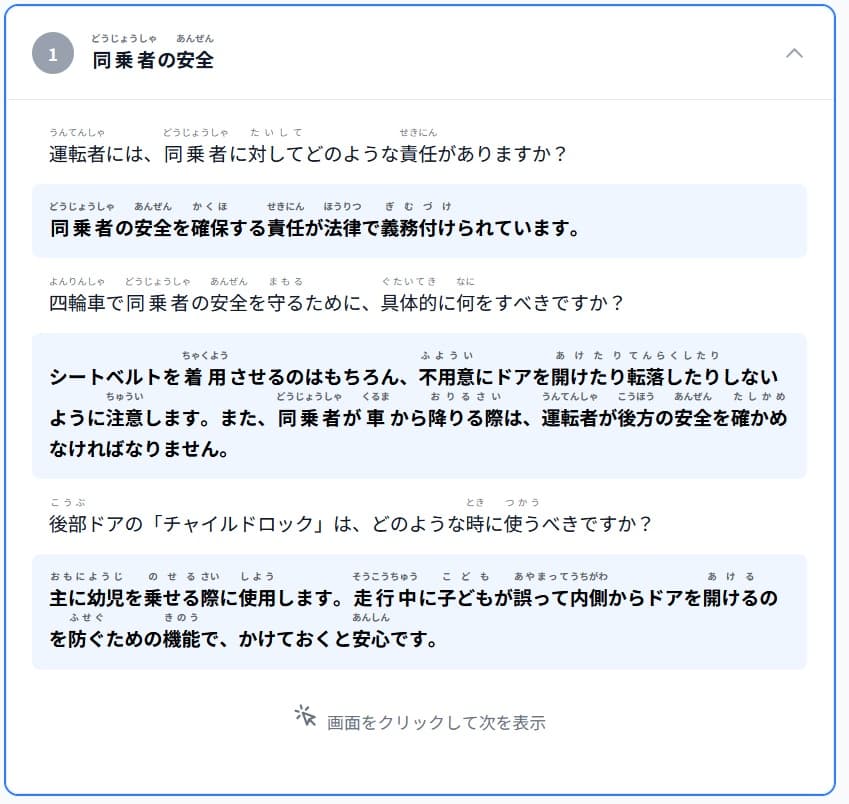
4. A dashboard that visualizes learning history
It automatically analyzes progress and accuracy rate to help you overcome weak areas.
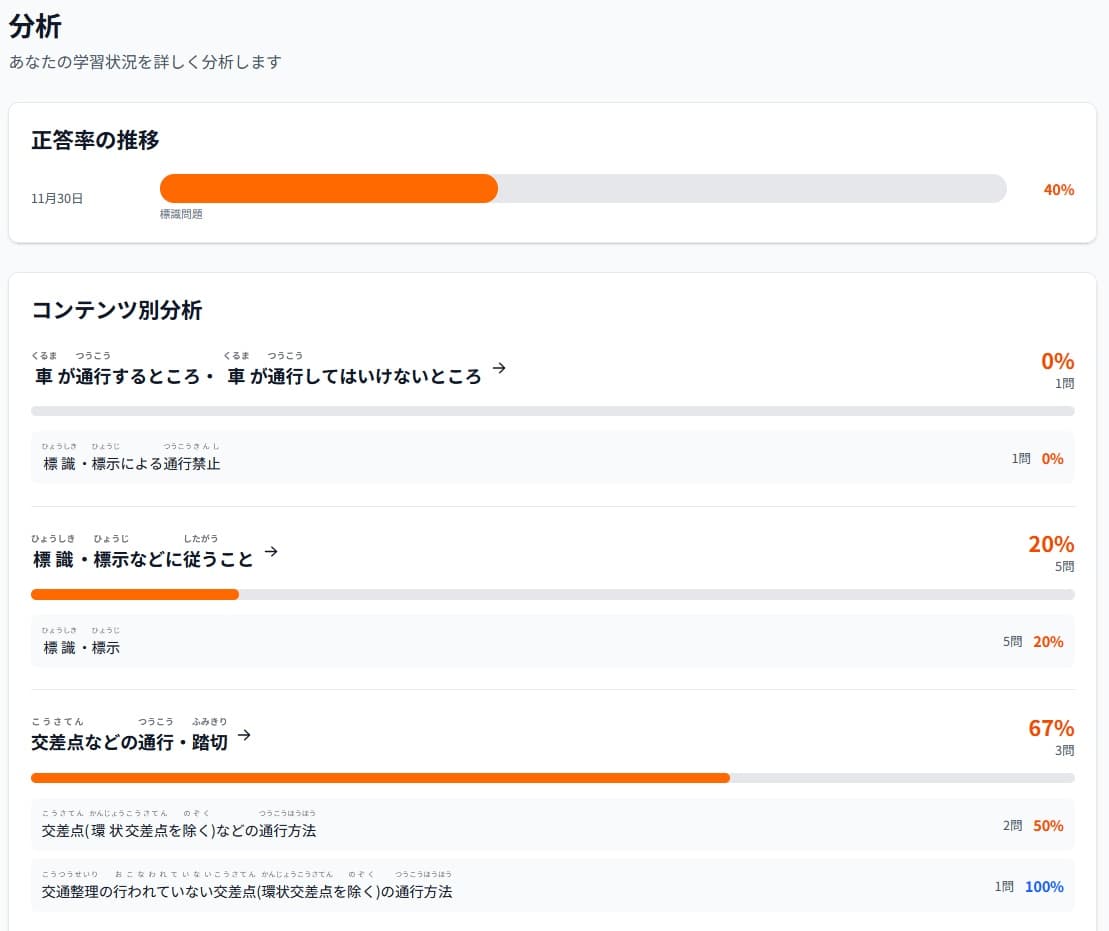
5. Supports 6 languages (Japanese, English, Chinese, Vietnamese, Burmese, and Indonesian)
Since students can study in their native language, even those who are unsure about their Japanese can use the course with confidence.
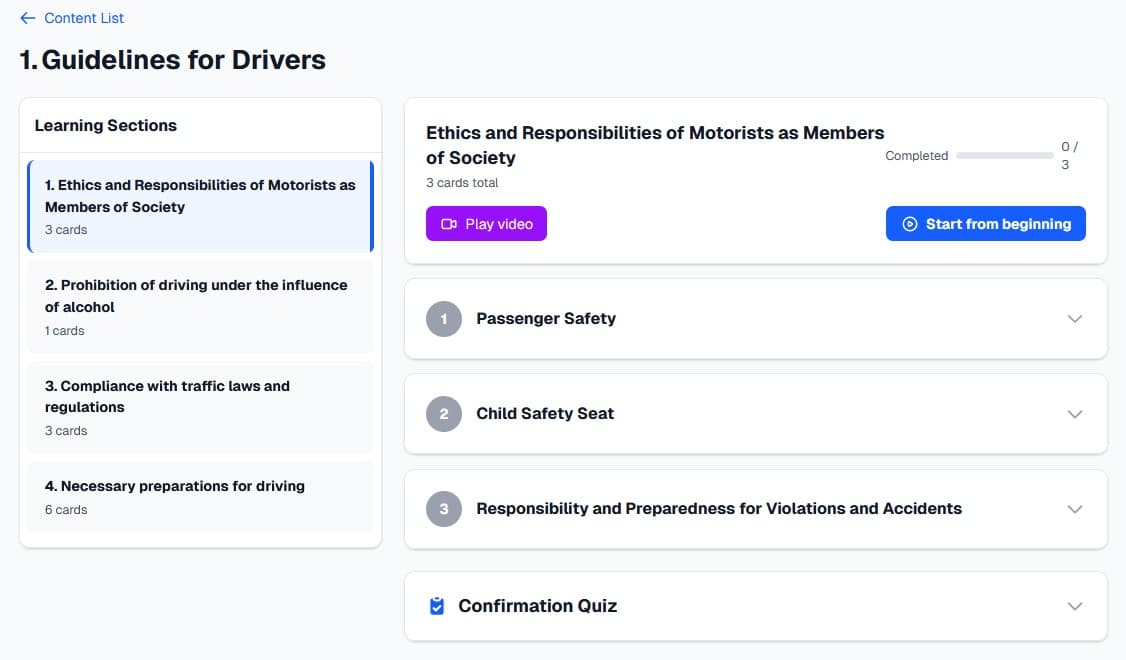
(English example)
Learn more → Knowledge Verification Measures Drivey
■ How to use
STEP 1. Select your application plan and make payment on the website
STEP 2. You will receive a login URL via email
STEP 3. Register a password of your choice → Start using it!
You can get started in just 3 easy steps.
We handle everything from translation to knowledge verification and skill verification! What is the Foreign Driver's License Conversion "Safety Package"?
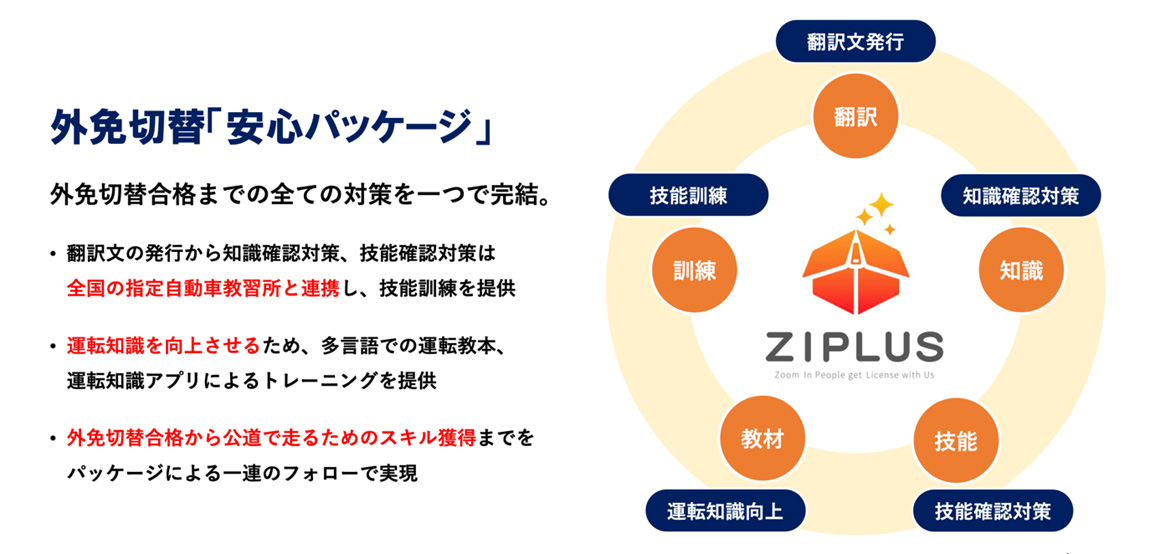
In this situation, ZIPLUS has come up with the Foreign Driver's License Conversion "Peace of Mind Package" with the aim of training foreigners to pass the test on the first try and drive safely on Japanese public roads by converting their foreign driver's license.
This program is a complete one-stop solution for all the steps you need to take to pass the foreign driver's license conversion test, as detailed below.
From issuing translated documents to the knowledge verification app Drivey, and for skill verification preparation (preparation in advance, driving practice/mock test preparation, review, and tips just before the actual test), we work with designated driving schools across the country to provide free practice.What's more, after passing the test, the system is designed to allow you to understand traffic signs and road markings necessary for safe driving on public roads in foreign languages.
Learn more
Summary of sample questions for knowledge verification (written exam)
An example of a written exam
Question 1: Drivers are not obligated to remind passengers to wear seat belts.
A.【×】
The key point in this question is "the driver's obligation for passengers to wear seat belts." Article 71-3 of the Road Traffic Act states that drivers are not only obligated to wear seat belts themselves, but also to ensure that passengers do so. Although the question states that there is "no obligation," in reality there is an obligation. If the driver simply says "please feel free," it is a violation of the law and may result in penalty points and a fine (however, there is no fine for riding in the back seat on public roads, but points will be assessed).
Question 2: When a traffic police officer directing traffic raises both arms vertically, the hand signal requires traffic traveling parallel to the officer's body to stop in the same way as a red light on a traffic light.
A.【×】
The hand signal that a police officer uses, with both arms raised straight up, corresponds to a yellow light at a traffic light. To traffic moving parallel to the officer's body, it has the same meaning as a yellow light, not a red light.
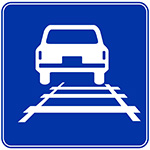
Question 3: Where this sign is displayed, only standard vehicles can travel on the track.
A.【×】
This sign means "Traffic permitted within the track area." It indicates that this is a section where it is permitted to travel within the tram tracks (track area). Normally, cars are not permitted within the track area (trams have priority). However, where this sign is present, cars (not only regular cars, but also large vehicles and motorcycles) are permitted to travel within the track area. The question states that "Only regular cars can travel within the track area," but the correct answer is "All cars can travel." This is an easily misunderstood question, as the illustration on the sign is of a regular car. Be careful.
Question 4: When leaving a gas station, you followed the guide's signal and slowly crossed the sidewalk.
A.【×】
The Road Traffic Act stipulates that when vehicles cross a sidewalk, they must not obstruct pedestrians (pedestrians have the right of way) and must stop and check for safety (slowing down is not enough). Even if there is a traffic guide present, vehicles are required to stop when crossing a sidewalk.
Question 5: Mopeds must make a two-stage right turn only at intersections with two-stage right turn signs.
A.【×】
For mopeds, when turning right on roads with three or more lanes in each direction, or when there are signs or markings instructing you to do so, or when traffic is being controlled, you must make a two-stage right turn. This is incorrect because the only cases are when there is a two-stage right turn sign or when the road has three or more lanes in each direction.
Question 6: When passing by a school or kindergarten bus with children or infants getting on or off, you must stop at the rear of the bus and thoroughly check the surrounding area for safety.
A.【×】
The Road Traffic Act does not state that "school buses must stop at all times when boarding or disembarking." However, to ensure the safety of children getting on and off, it is essential to "slow down" and "check for safety." The correct answer to this question is to slow down (slow down) and pass the side of the bus while making sure it is safe.
Question 7: If a pedestrian crossing a crosswalk stops to check your car, is it okay to just pass through?
A.【×】
A pedestrian may have stopped because they want to let cars go first, but legally cars are obligated to wait until the pedestrian has completely crossed or it is clear that they will not impede progress.
Question 8: When making a right turn, it is appropriate to signal 3 seconds before starting to turn.
A.【×】
Article 53 of the Road Traffic Act stipulates that when making a right turn, left turn, or other turn, you must signal approximately 30 meters before the intended action. The three seconds before the turn is the time to signal when changing lanes. Remember this so you don't get confused.
Question 9: A small amount of alcohol has little effect on driving, so it is not considered drunk driving.
A.【×】
Even small amounts of alcohol impair judgment and attention. If you exceed the legal limit (0.15 mg or more in exhaled breath), you will be considered driving under the influence of alcohol and will be subject to penalties. Even if your alcohol level is below the legal limit, you may be punished for drunk driving if your driving is clearly impaired.
Question 10: When parking, there was only 3.5 meters of space on the road to the right of my car, but there was little traffic so I parked there anyway.
A.【×】
According to the Road Traffic Act, when parking a car on the road, you are required to leave at least 3.5 meters of space on the right side of the car (the center of the road). This is to allow other cars and emergency vehicles to pass safely. Regardless of the amount of traffic, you cannot park if you cannot leave 3.5 meters of space.
To take the knowledge test (written exam)

General procedure for converting a foreign driver's license
Document screening (aptitude screening) ⇒ Knowledge verification ⇒ Skill verification
Make a reservation at the driver's license center
At most prefectural license centers, you must make a reservation in advance for a document screening and pass the screening before you can take the written test. Please check in advance with the license center where you will be applying to find out how to make a reservation.
For those who are unsure about their Japanese

Don't worry if you're worried about taking the test in Japanese! The test can be taken in multiple languages other than Japanese. Since the languages available vary depending on the license center, please check the details with the license center where you will be applying. (As of August 2025)
Tokyo
Arabic, Indonesian, Ukrainian, Urdu, English, Korean, Khmer, Sinhalese, Spanish, Thai, Tagalog, Chinese, Nepali, Hindi, Vietnamese, Persian, Portuguese, Burmese, Mongolian, Russian
Kanagawa
Arabic, Indonesian, Ukrainian, Urdu, English, Korean, Khmer, Sinhalese, Spanish, Thai, Tagalog, Chinese, Nepali, Hindi, Vietnamese, Persian, Portuguese, Burmese, Mongolian, Russian
Saitama
Arabic, Indonesian, Ukrainian, Urdu, English, Korean, Khmer, Sinhalese, Spanish, Thai, Tagalog, Chinese, Nepali, Hindi, Vietnamese, Persian, Portuguese, Burmese, Mongolian, Russian
Chiba
Arabic, Indonesian, Ukrainian, Urdu, English, Korean, Khmer, Sinhalese, Spanish, Thai, Tagalog, Chinese, Nepali, Hindi, Vietnamese, Persian, Portuguese, Burmese, Mongolian, Russian
Aichi
Arabic, Indonesian, Ukrainian, Urdu, English, Korean, Khmer, Sinhalese, Spanish, Thai, Tagalog, Chinese, Turkish, Nepali, Hindi, Vietnamese, Persian, Portuguese, Burmese, Mongolian, Russian
Osaka
Arabic, Indonesian, Ukrainian, Urdu, English, Korean, Khmer, Sinhalese, Spanish, Thai, Tagalog, Chinese, Nepali, Hindi, Vietnamese, Persian, Portuguese, Burmese, Mongolian, Russian
Fukuoka
Arabic, Indonesian, Ukrainian, Urdu, English, Korean, Khmer, Sinhalese, Spanish, Thai, Tagalog, Chinese, Nepali, Hindi, Vietnamese, Persian, Portuguese, Burmese, Mongolian, Russian
Please contact the License Center directly for the latest information and supported languages in other prefectures.
There are some countries that are exempt from the knowledge and skills verification when converting a foreign driver's license.
If you hold a driver's license from the following countries, you are exempt from the knowledge and skills check for foreign driver's license conversion.
Iceland Ireland Ireland United States of America United States of America (Limited to Ohio, Oregon, Colorado, Virginia, Hawaii, Maryland, Washington, and Indiana. However, Indiana is exempt only from skill verification.) (Limited to Ohio, Oregon, Colorado, Virginia, Hawaii, Maryland, Washington, and Indiana. However, Indiana is exempt only from skill verification.) |
England Italy Italy |
Australia Austria Austria Netherlands Netherlands |
Canada South Korea South Korea |
Greece |
Switzerland Sweden Sweden Spain Spain Slovenia Slovenia |
czech |
Denmark |
Germany |
new zealand |
Norway |
Hungary |
Finland France France |
Belgium |
Poland Portugal Portugal |
Monaco |
Luxembourg |
Taiwan |
lastly
What did you think? You probably found out there were many things you didn't know. As for the knowledge test (written test) for converting your foreign driver's license, passing on the first try is not a dream if you understand the basic traffic rules of Japan. It's a good idea to prepare thoroughly in advance, such as by checking the practice questions.
In addition, there are many license centers that can handle languages other than Japanese, so if you want to take the knowledge test (written test) in another language, it is important to check in advance.
Once you pass the knowledge test (written test), the final step is the skills test! Please also use this article.
For support regarding converting your foreign driver's license, please click here☟
①Issuance of a Japanese translation of a foreign driver's license: https://ziplus.jp/switching_license/translation
2) Foreign driver's license conversion knowledge test (written test) and skill test (practical test) preparation: https://ziplus.jp/switching_license/safety-pack-toc
We also provide full support from "issuing the translation" to "exam preparation" (1 + 2), so please contact us first.
For inquiries, please contact: https://ziplus.jp/switching_license/contact