table of contents
- Introduction
- Why passing the skill verification test (practical test) will become even more difficult from October 2025
- How to conduct skill verification (practical test)
- New examination items from October 2025
- Thorough explanation of the details of demerit points for skill confirmation (practical test) for changing to Gaimen!
- Also supports new skill verification measures! What is the Foreign License Conversion "Safety Package"?
- Finally, for support regarding converting your foreign driver's license, please click here☟
Introduction
I want to switch (change) my foreign Driver's License to a Japanese Driver's License, but I'm worried because I have no experience driving in Japan. No matter how many times I try, I fail the skill test (practical test)... For those of you who have such troubles!
The most difficult part of converting the foreign Driver's License to a Japanese one is the skill confirmation. In fact, there are many people who fail the exam many times and end up going to a driving school and getting their license from scratch. However, driving technique is not required in the actual test. You will be checked to see if you understand Japanese traffic rules and are aware of the important points for safe driving. In other words, if you firmly understand these rules and points, passing the exam on the next try is no longer a dream.
Why passing the skill verification test (practical test) will become even more difficult from October 2025

Until now, the skill verification test (practical test) for converting a foreign driver's license has been difficult, with a pass rate of only 20-30%.
However, with the addition of new examination items, the exam will become even more difficult from October 2025.
In this article, we will thoroughly explain and cover all nine points of skill verification for foreign driver's license conversion, as well as the new examination items and deduction items.
*According to our research as of August
How to conduct skill verification (practical test)
The exam is scored on a deductible scale with a maximum score of 100 points, and a pass mark is 70 points or above.
The total distance traveled (meters) is approximately 1,200 meters.
The challenges for standard vehicle, semi-medium-sized, medium-sized, and large vehicle licenses are as follows.
1. Running on the main course and the circular course
1) Traveling on a straight section
② Stopping at designated places
2. Crossing the intersection (passing the traffic light)
3. Driving on a curved course
4. Driving on a curved course
5. Passing through obstacle-placed areas
The testing center is large, but the practical test course is fixed. I think that if you can do image training, you can dispel your anxiety.
Let's take a look at nine points about basic driving one by one.
How to get in and out of a car, driving posture, etc.
① Able to get in and out of a car properly
[Getting in] Check the back of the car → Go around from the passenger side to the front and check the front of the car → Go to the driver's seat → Make sure you are not blocking traffic coming from behind, and if there are no problems, get in quickly → Stop the door once just before closing it, and then close it.
[Getting out] Apply the parking brake, put the gear in P, and turn off the engine → Unbuckle your seat belt and push your seat all the way back → Check that it is safe behind you, open the door slightly, and let traffic behind you know that you are opening the door.
② You can maintain a correct driving posture.
・Sit deeply
-Adjust the driver's seat forward and backward
・The upper body is placed on the handlebars
・Adjust the rearview mirror without moving your face as much as possible.
・Be careful not to twist your seat belt
Make sure the gear lever is in the "P" position, then adjust the side mirrors.
Traffic division
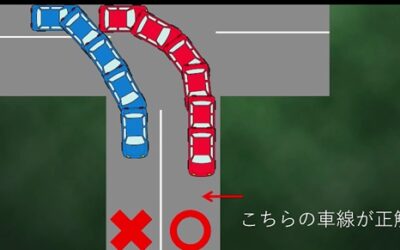
① Drive on the left side of the center of the road.
② If there are two lanes going in the same direction, use the left lane.
Keep in mind that driving on the right side of the road will result in driving in the wrong direction, and your test will end immediately. Even if the test site is large, make sure you don't make the wrong decision about which side to drive on.
Obey traffic signals and signs
① If there is a stop sign or a flashing red light, you must stop before the stop line.
To be precise, it is within 2m from the stop line.
If you do not stop it once, failure to do so will result in immediate termination of the test!!
② After stopping for a while, check that both sides are safe so as not to obstruct the progress of vehicles passing on the intersecting road, and then start moving.
③ If the light is red, be sure to stop just before the stop line.
How to check for safety when changing lanes (Most important!)
1. Check behind you in the rearview mirror and signal approximately 3 seconds before changing lanes.
② Make sure there are no oncoming vehicles and check the safety on the right side using your rearview mirror and with your own eyes before changing lanes.
Here are the correct steps for changing course. Make sure you memorize these five steps.
1. Check behind you with the rearview mirror
2. Check the side mirrors of the direction you are changing to
3. Turn on your turn signal in the direction you want to change course (3 seconds)
4. Check behind you again in the rearview mirror, look in the side mirrors, and look directly*.
5. Face forward and steer
*Visual inspection = looking directly at a blind spot with your own eyes

Passing obstacles sideways (most important!)
① When changing lanes, make sure it is safe ahead and that no vehicles are approaching from behind.
(Course change 4.)
② When crossing the center line to change lanes, be careful of oncoming vehicles.
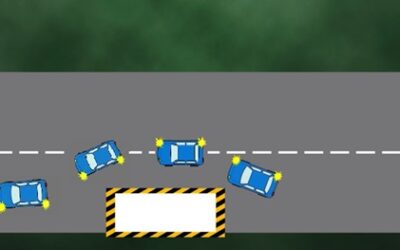
[How to avoid obstacles correctly]
- The side with the obstacle ahead of it will wait.
- Maintain a distance of at least 1m, and avoid crossing the center line.
- When avoiding obstacles and returning to your original position, you must confirm and signal your intention to change course.
(Course change 4.)
Example of failure: Interfering with oncoming vehicles → The test will be canceled immediately.
Drive completely in the oncoming lane → keep to the right and the test ends immediately.
How to turn right

1. Check the safety of the right side with your own eyes and the rearview mirror (room mirror, right door mirror,
Visually check to the right), signal, and then move to the center of the road in advance (changing lanes 4.)
2. Turn right while driving slowly just inside the center of the intersection so as not to impede oncoming traffic.
3. Keep to the left after turning right
How to turn left
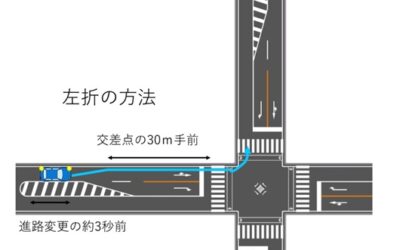
1. Check the safety of the left side with your own eyes and the rearview mirror (room mirror, left door mirror,
Visually check to the left), give a signal, and then move to the left edge of the road in advance (change of course 4.)
2. Slow down, check for traffic and safety on both sides, then make a tight left turn.
Priority decision
If two vehicles attempt to enter an intersection with the same width but no traffic control at the same time, vehicles approaching from the left will have priority. In that case, yield to the vehicle coming from the left.

[The road ahead is the priority road]. The intersection where the center line extends into the intersection is the priority road.
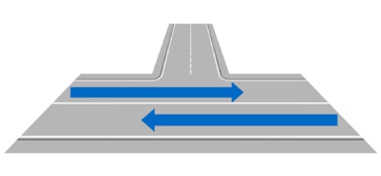
[Turn right] case. Even if you enter the intersection first, you must not obstruct oncoming vehicles going straight or turning left.
New examination items from October 2025
The following three new examination items will be added from October 2025.
■ Drive carefully near pedestrian crossings
① Ease off the accelerator a little before the crosswalk and check both sides
→If it is clear that no one is crossing, you can continue on.
②Make sure to check for pedestrians
→ If there are pedestrians, come to a complete stop
■ Follow correct procedures at railroad crossings
① Come to a complete stop before the stop line (slow driving is not allowed)
② Open the window and listen for noise (do not enter if the alarm is ringing)
→ The driver's side window needs to be rolled down
3. Make sure there are clear safety checks on both sides.
■ Use turn signals more accurately
① Turn on your turn signal at least 3 seconds before changing lanes or turning right or left.
→ Signal about 3 seconds before changing lanes, and when turning right or left at an intersection, signal 30 meters before the turn.
2. Always use your turn signal when starting off
Items for suspension during skill check
・ Keep to the right
When driving or attempting to drive on the right side of the center of the road
・ Ignoring traffic signals
1. When a red light is displayed and any part of the vehicle exceeds or is about to exceed the legally required stopping position.
② When a yellow light is displayed and part of the vehicle exceeds or attempts to exceed the stopping point even though it is safe to stop.
・ No temporary suspension
道路標識等による一時停止の指定場所で、停止線(停止線のない場合は交差点の直前)の手前で停止しない場合
・ Veering off course
試験管の指示に従わずコースから逸脱した場合
Contact with an obstacle
①場内コースに設置してある障害物等(ポール・カラーコン)に、車体(二輪車では運転者の身体も含む)が強く接触したとき、または軽く接触した後にそのまま走行を継続したときや、継続しようとしたとき
② When there is a risk of the vehicle coming into contact with pedestrians, vehicles, buildings, etc.
・ If the examiner operates the brakes or steering
運転操作が確実でなく、道路や周囲の交通、試験車の状況等に応じた他人に迷惑をかけないような速度および方法で運転しないため、他人に迷惑をかけそうな場合で試験管がハンドルやブレーキ、その他の操作を補助したとき、または是正措置を指示したとき
A thorough explanation of the points deduction details for the skill verification (practical test) for foreign driver's license conversion!
[10 points deduction details] Points to be especially careful about
| 1. Retrograde (small) | If you go against the direction you are trying to travel |
| 2. Maintaining speed (outside of the task) | If the required speed cannot be achieved due to slow acceleration, etc. |
| 3. Safety unconfirmed | Although the driver stopped temporarily or slowed down, the driver failed to check the safety of the vehicle sufficiently, causing the driver to overlook the vehicle or be delayed in finding the other party. |
| 4. Too fast (small) | If the speed is faster than the speed appropriate for the road and traffic conditions (excluding when there is an obligation to slow down) |
| 5. Sudden steering wheel | Changing the direction of travel by suddenly operating the steering wheel. |
| 6. Light-headedness (small) | If the steering wheel is unstable and unsteady |
| 7. Curvilinear balance/refraction balance | You can safely balance your ride with the crank and S-curve. |
| 8. Violation of prohibition on changing course | If you change your course unnecessarily (meaninglessly) |
| 9. Violation of traffic classification by direction of travel | When a traffic classification regarding the direction of travel is specified at an intersection, when the vehicle does not pass according to the designated classification, or when the vehicle does not intend to pass. |
| 10. Poor prioritization | - When you make a vehicle approaching from the left at an intersection without traffic lights slow down or stop. - At an intersection without traffic lights, when the intersecting road has priority, and vehicles traveling on the priority road are forced to slow down or stop. - At an intersection without traffic lights, when vehicles traveling on an intersecting road that is clearly wider than the road the test vehicle is traveling on are forced to slow down or stop. When turning right at an intersection, causing oncoming vehicles to slow down or stop When starting from a place designated as a stop sign by a road sign, etc., causing vehicles traveling on an intersecting road to slow down or stop, etc. |
| 11. Violation of restrictions on the use of horns, etc. | ・When the horn is sounded without due consideration (irrationally) - When the horn is not sounded in a place designated by road signs, etc. |
| 12. Violation of sudden braking prohibition | This is a violation of intentionally applying sudden brakes to slow down or stop suddenly, rather than to avoid an accident. |
| 13. Not maintaining following distance | When you catch up to a stopped vehicle (waiting at a traffic light, etc.) and stop, you do not maintain or attempt to maintain a distance of approximately 1.5m or more between you and the vehicle in front. |
| 14. Alarm | |
| 15. Mud splash driving | When driving through mud or puddles, the vehicle splashes mud or muddy water and causes or is likely to cause a nuisance to others. |
[Details of 5-point deduction] Points to pay particular attention to
| 1. Failure to signal, etc. (change of course) | The signal for a change of course must be given approximately 3 seconds before the change of course and must continue until the change of course is completed. |
| 2. Failure to signal (right/left turn) | When making a right or left turn at an intersection, etc., start flashing your turn signal 30 meters before the turning point, and keep the turn signal flashing until you complete the turn. |
| 3. Inappropriate measures to prevent entanglement | - When a vehicle turns left or enters a roundabout and does not take measures to prevent being hit - When there is a motorcycle immediately before an intersection in the direction of travel, or when traveling alongside a motorcycle, you do not allow the motorcycle to go ahead or proceed ahead. |
| 4. Traffic lane violation | When you drive or attempt to pass in the right-most vehicle lane in a lane where no traffic classification is specified. |
| 5. Route change violation (narrow road) | ・When turning left onto a narrow road (such as a curve or S-shaped road), failing to change lanes to the left in advance (from about 30m) ・When you change lanes to the left but are more than 1m away from the left edge of the road ・When you have completed the left lane change within approximately 30m of the entrance to a narrow course - When the vehicle is turned to the right just before the entrance to a narrow course |
| 6. Route change violation (intersection) | Vehicles behind the intersection are prohibited from overtaking or overtaking the vehicle in front of them at an intersection or within 30 meters before the intersection. |
| 7. Violation of right/left turn method | It is a violation of the rules that cars must follow when turning right or left at an intersection. Before entering an intersection, when turning left, you must move your vehicle as close to the left as possible, and when turning right, you must move your vehicle as close to the center as possible (or to the right if it is a one-way street). Failure to follow this rule will be a violation of the intersection right/left turn method. |
| 8. Cut back (excluding narrow road course) | If you turn back due to poor operation or poor judgment |
Also supports new skill verification measures! What is the Foreign License Conversion "Safety Package"?
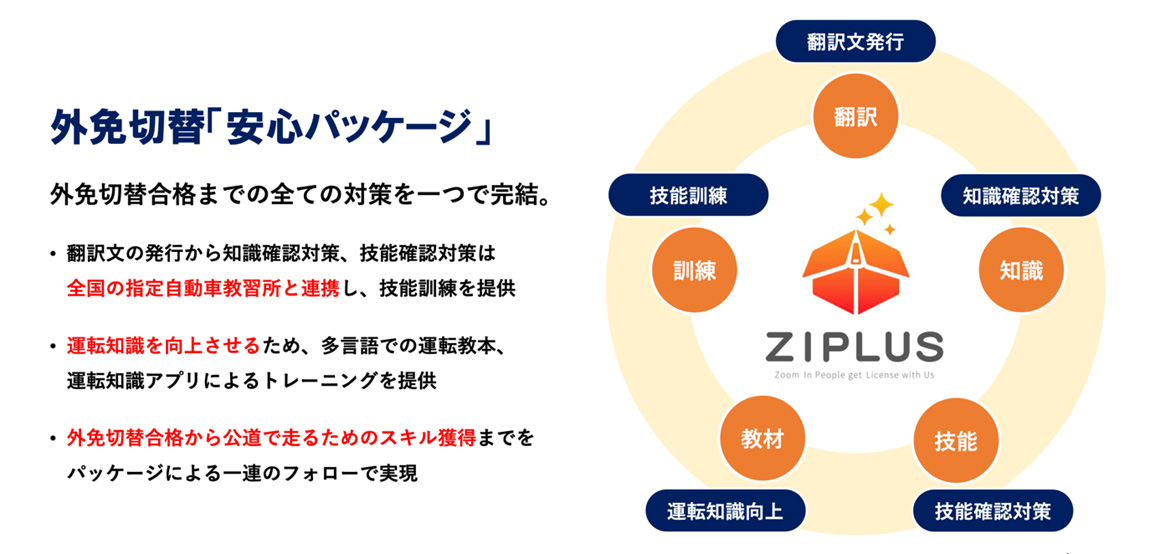
In response to these challenges, ZIPLUS has developed the Foreign Driver’s License Conversion “Fast-Track Package”. This program is designed to help foreign residents pass the skills test on their first attempt and to ensure they can drive safely and confidently on Japanese public roads after converting their foreign driver’s licenses.
This program is an all-in-one package that covers every step necessary to pass the foreign driver’s license conversion test in Japan, as outlined below.
From the publication of the translation Knowledge Check Measures, It also supports skills assessment (practical examination). The preparation program (including pre-test preparation, driving practice and mock test preparation, review, and tips for the day before the actual test) is conducted in cooperation with designated driving schools nationwide to provide skills training. Furthermore, after passing the exam, the program is designed to help users understand traffic signs and road markings necessary for safe driving on public roads, including those in foreign languages.
We also support newly added items in the skill verification (practical test).For more information, click here
Finally, for support regarding converting your foreign driver's license, please click here☟
What do you think? If you have a good understanding of Japan's traffic rules and drive considerately, you can aim to pass the driving skills test (driving skills confirmation)!
①Issuance of a Japanese translation of a foreign driver's license: https://ziplus.jp/switching_license/translation
2) Foreign driver's license conversion knowledge test (written test) and skill test (practical test) preparation: https://ziplus.jp/switching_license/safety-pack-toc
We also provide full support from "issuing the translation" to "exam preparation" (1 + 2), so please contact us first.
For inquiries, please contact: https://ziplus.jp/switching_license/contact