

Introduction
So, you’ve landed in Japan and realized that public transportation, while fantastic, doesn’t always reach the quiet mountainside village you want to explore or that highly instagrammable roadside view. Maybe you landed a great job but it requires a license. That’s probably when you start thinking “Can I actually drive here?” And if you’re planning a longer stay, the question quickly shifts to: “How do I get started with license conversion in Japan?”
Whether you’re a new arrival or a long-term resident finally ready to tackle the process, this guide aims to gather all the necessary information in one place. So let’s start with the basic question.
Can You Drive with a Foreign License in Japan?
The easy answer to this is maybe. Depending on the country you obtained the license and its potential agreements with Japan, there are several options available and the processes involved may also differ significantly. Listed below are the main methods of driving with your foreign license.
International Driving Permit (IDP) Basics
If you’re a tourist or a short-term visitor, you might not need to convert your license right away. Japan accepts International Driving Permits based on the 1949 Geneva Convention and it is valid for up to one year from your entry date.
However, once you become a resident (with a visa longer than 90 days), the IDP isn’t enough. That’s when license conversion becomes essential.
Countries Eligible for Direct Conversion
Some countries enjoy a relatively easy conversion process. If you’re from places like the UK, Canada, France, Germany, Australia, Scandinavia or South Korea, you can skip the written and driving tests entirely. For the others, you are in for a bit of a challenge. Fear not, with the proper preparation (which I will detail below), you’ll be able to navigate the process easily enough.

What is Gaimen Kirikae?
“Gaimen Kirikae” (外免切替) literally means “foreign license switch”. It’s Japan’s official process for converting a valid non-Japanese driver’s license into a Japanese one. License conversion offers a slew of benefits over the other driving school methods, even for those who have to take the written and driving tests. Some of these benefits are:
- No need to attend expensive driving schools
- Get legally certified to drive in Japan without starting from scratch
- Easier mobility and job opportunities, especially in rural areas
- Significantly cheaper
Countries Eligible for Simplified Conversion
List of Recognized Countries
If you’re lucky enough to come from a country recognized by Japan for mutual license agreements, the process becomes a breeze. These are:
| Iceland | Ireland |
| England | Italy |
| Austria | Australia |
| Netherlands | Canada |
| South Korea | Greece |
| Switzerland | Sweden |
| Spain | Czech Republic |
| Denmark | Germany |
| New Zealand | Norway |
| Finland | France |
| Belgium | Portugal |
| Luxembourg | Taiwan |
The Following US States Are Also Exempt:
- Hawaii
- Maryland
- Virginia
- Washington
- Ohio
- Oregon
- Colorado
Why Some Nations Have Easier Paths
Japan has reciprocity agreements with countries that maintain similar standards for road safety and testing. The requirements for getting a license vary greatly by country and Japan is definitely on the stricter side.
Documents Required for License Conversion in Japan
No matter which country you hail from, there will be a list of documents that you have to submit to your local license center in order to start the license conversion process.
Checklist of Essentials
- Valid foreign driver’s license
- Translation of license (Get it through us, JAF or other certified institutions)
- Residence Card (Zairyu Card)
- Documents that can verify you have stayed in the license-issuing country or region for at least 3 months (e.g., Passport, Certificate of Entry/Exit Record)
- 1–2 Passport-sized photos
- Juminhyo (住民票)
Tips for Gathering Proof of Residence/Driving History

Proof that you’ve lived in the country of issue for at least 3 months after receiving your license is crucial. Use stamps in your passport, old utility bills, or work contracts to help confirm this.
Getting Your Documents Translated
The first step in the Gaimen Kirikae process is to get your foreign driver’s license translated. This is an unavoidable step no matter which country you come from. The important thing to note is that the translation needs to be done through an authorized organization/institution. The fee is typically no more than 6000 yen and the process duration is between 2-4 days. I have taken the liberty of listing some of the most commonly used institutions below.
Where and How to Get It Done
The most commonly used translation services are Ziplus and Japan Automobile Federation (JAF). You can request translations by online application, mail or phone call and the translation and issuing process can take 1-2 business days or up to 2 weeks depending on where you go. These companies can translate licenses from a wide range of countries, but not all. If your country is not listed in their services, you can ask the consulate or embassy.
The License Conversion Process Step-by-Step
Getting the official translation only lands you at the foot of the mountain. There are many steps to get through, but the main obstacles that most foreigners struggle with are the written test and especially the driving test. More on those later. Here is a list of each step to convert your license.
- Book an appointment at your local Driver’s License Center
- Submit all documents for inspection
- Take an eye test
- Take a written test (if required)
- Schedule a practical test (if required)
- Receive your shiny new Japanese driver’s license!
It is easy to look at the list of steps and be overwhelmed at just how much needs to be done, and how many parties are involved. Fret not, it is quite straight-forward when you break down each step.
Taking the Written Test
The written test contains 10 true/false questions, and is often available in English. The test is significantly shorter than the test you would need if you took the exam from scratch. The written test should not pose too much of a challenge if you take some time preparing with relevant materials. Keep in mind; what is considered common sense can vary depending on the country and there are also questions about elements unique to Japanese traffic laws.
*Important note: From October 1st 2025, the written test will feature 50 questions, and a passing score of 45!
Common Pitfalls and Tips
The written test is not necessarily the biggest hurdle you will face, but it always helps to be prepared for some common mistakes and pitfalls. I have listed a few tips below:
- Study from official materials or expat blogs
- Watch out for “double negatives” in the test wording
- Make sure to memorize anything that seems unique to the Japanese traffic laws
The Practical Driving Test in Japan
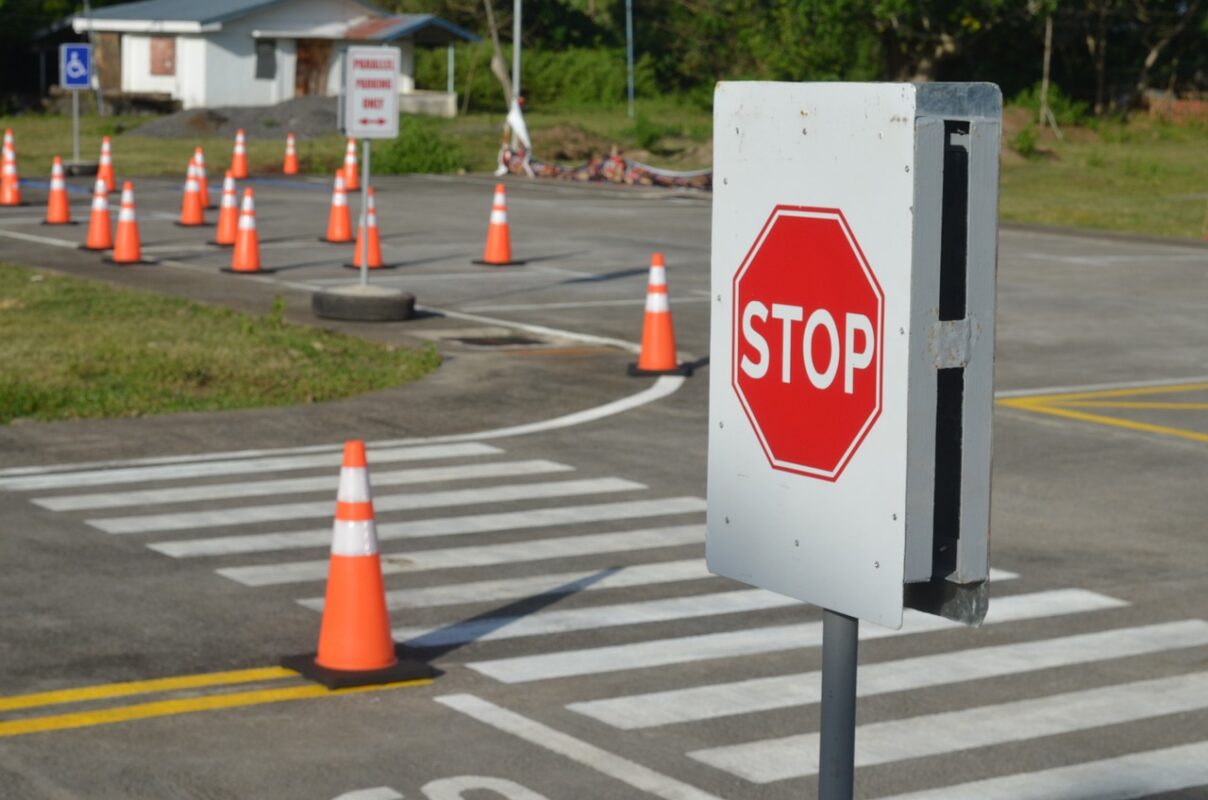
Unlike real-world driving, this test happens on a closed circuit, complete with tight turns, S-curves, and unexpected stop signs. The total distance you have to travel during the assessment is around 2 kilometers.
Tips to Pass on the First Try
- Signal early (3 seconds rule!)
- Check mirrors and look over your shoulder every single time
- Stop completely at stop signs (yes, completely)
- Don’t rush; confidence and calmness win the race
Find a comprehensive list of tips and pitfalls to avoid in our textbook Road Ready in Japan ( found as part of our Fast-Track Package)
What if You’re Not from a Recognized Country?
If your country isn’t part of Japan’s list for simplified conversion, don’t worry, it just means a few extra hurdles. You’ll need to take both the written test and the practical driving test, the latter of which is widely considered the biggest challenge.
In some cases, you may also be asked to provide detailed driving history, or prove the validity and origin of your license through embassy certifications. Be sure to check with your nearest Licensing Center to understand the exact requirements for your nationality.
Training and Preparation
Many expats opt to take a few lessons at a Japanese driving school to get familiar with the local rules and the layout of the driving test course. Though it’s not mandatory, it’s a smart move to avoid multiple retests ( and the long waiting time that comes with it).
Common Challenges and How to Overcome Them
Most of the licensing staff only speak Japanese. The License centers do not offer English support, so you may want to consider bringing a friend or translator with you, or using an app for translation.
Navigation and Scheduling Issues
Driver’s License Centers are often located far from major city centers. Appointments can fill up quickly, and waiting times are long, so plan ahead and book online or by phone as early as possible. Also, give yourself a full day for the visit like you might do when you go to renew your visa or have errands at city hall.
Time frame and Costs Involved
After reading all of the above regarding the license conversion process, you might be wondering how long it takes and how much the individual components cost. While the process itself is fairly straightforward as far as the Japanese paper mill is concerned, you will have to estimate at around 6 months total from ordering the translation and to the fateful day where the Japanese driver’s license lands in your hands.
Below is a rough timeline you can expect for each step:
| Step | Estimated Time |
| Booking the first appointment | 2 to 4 months |
| Document verification & written test | 1 day (some delays possible) |
| Scheduling the driving test | 3 to 4 months |
| Receiving your license | Same day or 1-2 weeks |
Japanese License Conversion Price
Converting your license is by far the cheapest option but each step will still set you back a small fee depending on the different alternatives you can choose at various parts of the process.
Here’s a ballpark of the costs you may encounter in Tokyo:
- License Translation: ¥3,000-6,000
- Application Fee: ¥2,500
- Written Test: ¥1,500
- Driving Test (if required): ¥2,000–¥3,000
- Photos and admin fees: ¥1,000
- Test-prep materials: ¥6,000-20,000
- Driving lessons: ¥40,000-60,000 (depending on amount needed etc.)
Total: Around ¥7,000–¥12,000 for the process itself, and around ¥110,000-120,000 if you get test-prep materials. You might think that the test-prep is expensive, but the truth is it is absolutely worth it to pass on the first try. The passing rate of foreigners taking the driving exam is less than 20% and much of this comes down to a lack of preparation. In contrast, a driving camp will set you back ¥210,000 at it’s lowest possible price.
Renewing Your Japanese Driver’s License
Alright, you’ve finally got your tired hands on the coveted Japanese driver’s license. You’ve been through a lot haven’t you? In this section I will tell you how to keep your precious license and how often you have to renew it.
- First-time license: Valid for 3 years
- Standard renewal: Every 5 years (or 3 for certain cases)
- You’ll receive a notice by mail about a month before your license expires
Just head to your local License Center with your current license, My Number card, and photo. You may need to attend a short lecture, especially if it’s your first renewal or if you’ve had traffic violations.
Updating Address or Personal Info
It’s required by law to update your address if you move. Visit the nearest police station or licensing center with your license and residence card to make changes.
Tips from Expats Who’ve Done It
You’ve now heard a lot from me, and while I am as trustworthy as they come, you don’t have to rely solely on my word. Below are some quotes from previous customers of ours who got through the conversion process.
- “The written test was easier than I expected, but the driving test was really strict. Don’t forget to exaggerate every head check!” – Sarah, from Florida
- “I failed twice before realizing I needed to take a few lessons to learn the test-specific techniques. Worth it!” – Chiharu, from California
- “Bringing all my documents in perfect order helped a lot. They appreciated that I was prepared.” – Lena, from Germany
What They Wish They Knew
When we interviewed them, we also made sure to ask what they wished they knew beforehand. Below I made sure to gather the three most common answers we heard from our customers:
- Appointments are booked weeks, even months in advance
- “Driving like you would in your home country won’t cut it here”
- Even confident drivers may struggle without practice on the test course due to the specific rules involved
Alternative: Getting a Japanese License from Scratch

If your foreign license isn’t eligible or has expired, or if you took the license many years ago and virtually never got to drive, attending a Japanese driving school might be your only option. There are two main options for getting a new license in Japan. One is regular driving lessons, and while this option is the most flexible option, it is also by far the most time-consuming and costly. The second is attending driving camps, an intensive course where you study everyday for two weeks while staying at an accommodation provided by the school. This option is the best if you are able to commit the time.
Driving Schools and Curriculum
Schools offer both manual and automatic transmission courses, and usually provide study materials in Japanese (and sometimes English). Expect to:
- Attend classroom sessions
- Pass multiple in-house tests
- Pay between ¥250,000 and ¥350,000
Though pricey, it’s often the most reliable way to obtain a Japanese license.
Useful Resources and Contacts
Here are a few links and hotlines that can be very helpful to get you started:
These services offer official translations of your driver’s license. JAF has a wider range of countries supported but Ziplus also offers driving training and test prep materials for the license conversion written test and driving exam.
FAQs About Converting Your Foreign Driver’s License in Japan
No. You must be a legal resident of Japan to apply for license conversion.
It’s considered unlicensed driving, which could lead to fines, license suspension, or even deportation.
Yes, companies like Ziplus and some embassies provide valid translations as well.
Usually 3 to 5 years, depending on your age and driving history in Japan.
After the written test you have 6 months to pass the driving test. If you fail to do so within this period, you will have to do the entire process over again. Additionally each retake of the driving test costs money and most importantly-a lot of time between appointments, so practice thoroughly.
Yes, you can apply for an International Driving Permit once you have a Japanese license.
Conclusion
Converting your foreign driver’s license in Japan doesn’t have to be a headache. Yes, the gaimen kirikae system is a bit bureaucratic, and yes, the driving test is known to be tough. But thousands of foreigners manage it every year, and with the right preparation, you might even pass on the first try!
If you have any questions, ask away in the comments or contact us on social media or through the contact page!


![[2025 Complete Guide] How to Prepare for Gaimen Kirikae Tests in Japan](https://ziplus.jp/road-ready/wp-content/uploads/2025/06/a_7.jpg)